Antiphospholipid Syndrome and Pregnancy: What the Latest Research Says
Reviewed and approved by Dr. Prakruthi Jaladhar, Rheumatologist, Co-Founder
A calmer place to start
If you searched for antiphospholipid syndrome and pregnancy at two in the morning after a hard conversation with your doctor, or after a miscarriage that still does not have an explanation, take a breath before you read any further. What you are looking for is not a list of everything that could go wrong. You already know that list, or you are afraid you are about to learn it. What actually helps right now is understanding what is happening in your body, and what specialists today can actually do about it.
Antiphospholipid syndrome, often shortened to APS, is an autoimmune condition where the immune system makes antibodies that make blood clot more easily than it should. During pregnancy, some of those clots can form in the tiny blood vessels of the placenta, which is why APS is connected to miscarriage, stillbirth, and other complications. That connection is real, and it deserves to be taken seriously. It is also, and this is the part that gets lost in late-night searches, a condition that specialists have gotten meaningfully better at managing. Most pregnancies affected by APS today are supported by a fairly well established treatment approach, close monitoring, and a care team that knows exactly what to watch for.
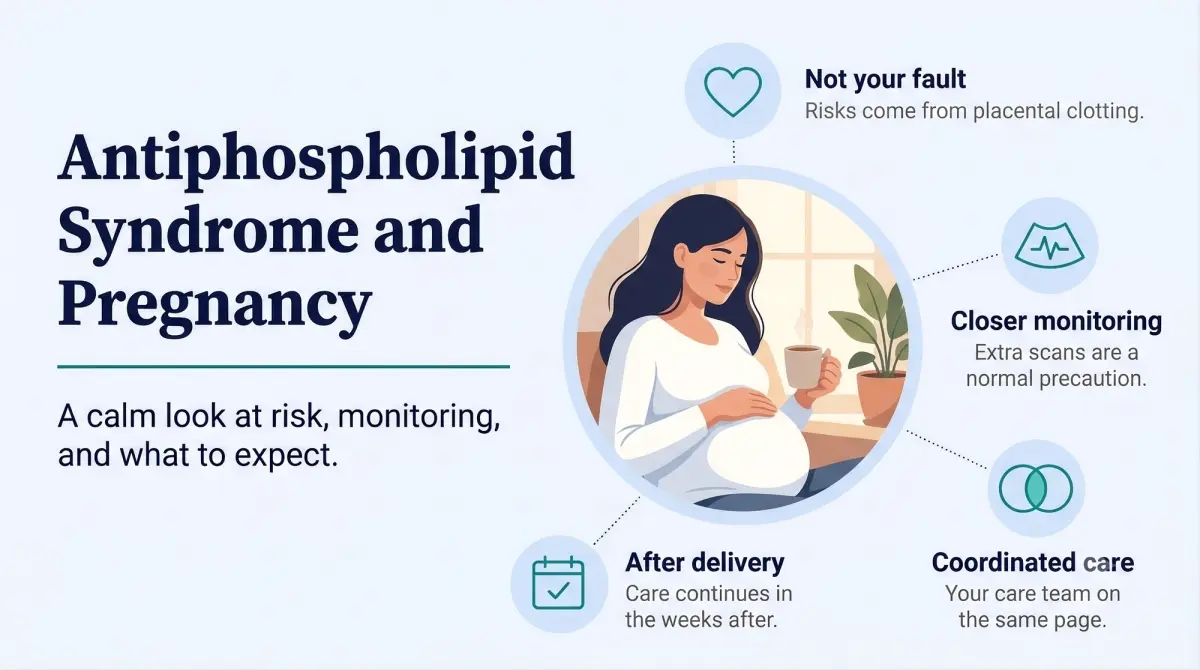
This article walks through what current research and specialist guidance say about antiphospholipid syndrome and pregnancy, in plain language, without minimizing what is genuinely hard about this. Whether you were just diagnosed, are trying to conceive, or are already pregnant and looking for reassurance, this is meant to sit with you like a steady hand, not another source of fear.
Key takeaways
- Antiphospholipid syndrome is a treatable clotting disorder. A diagnosis does not mean pregnancy is impossible or automatically unsafe.
- The main pregnancy risks, recurrent miscarriage, stillbirth, preeclampsia, growth restriction, and preterm birth, are caused by clotting in the placenta's blood vessels, not by anything you did.
- Specialists currently have a well established treatment approach they use to support a pregnancy affected by APS, decided individually with your care team.
- Coordinated care between a rheumatologist or hematologist and a maternal-fetal medicine specialist tends to produce the strongest outcomes.
- More frequent scans and check-ins are a protective, normal part of managing this condition, not a sign that something has gone wrong.
- With appropriate treatment, most people with APS go on to have successful pregnancies and healthy babies.
What antiphospholipid syndrome actually does during pregnancy
What is happening inside your blood vessels
In antiphospholipid syndrome, the immune system produces antibodies that target proteins attached to phospholipids, a type of fat found in cell membranes and involved in normal blood clotting. These antibodies make the blood more prone to forming clots than it should be, in blood vessels anywhere in the body. Outside of pregnancy, this can show up as blood clots in the legs or lungs, strokes, or a distinctive lace-like rash on the skin. During pregnancy, the same clotting tendency can affect the small blood vessels that supply the placenta.
How this shows up as a diagnosis
APS is usually diagnosed through a combination of clinical history, such as a blood clot or recurrent pregnancy loss, and blood tests that detect specific antiphospholipid antibodies. It can occur on its own, known as primary APS, or alongside another autoimmune condition, most commonly lupus, known as secondary APS. Either way, the pregnancy risks and the general treatment approach are similar.
Why this condition raises pregnancy risk
Miscarriage and stillbirth
Clots that form in the small vessels feeding the placenta can interfere with the blood and oxygen supply to a developing pregnancy, which is why APS is linked to recurrent first-trimester miscarriage as well as later pregnancy loss and stillbirth. This is one of the clearest reasons specialists recommend starting treatment early, often as soon as a pregnancy is confirmed, or even before conception in some cases.
Preeclampsia and growth restriction
APS also raises the risk of preeclampsia, a condition involving high blood pressure and strain on organs like the kidneys and liver, and of intrauterine growth restriction, where a baby grows more slowly than expected because the placenta is not delivering enough blood flow. Both of these are reasons why pregnancies affected by APS are usually monitored more closely than average.
It's the placenta, not you
It is worth saying plainly: these risks come from a clotting problem in the placenta's blood vessels, not from anything a person did or did not do. Miscarriage and pregnancy complications tied to APS are not caused by stress, diet, or lifestyle. They are caused by antibodies that most people never knew they had until pregnancy, or repeated loss, brought the condition to light.
What specialists are currently recommending
A well established treatment approach
For pregnancies affected by APS, specialists currently follow a well established treatment approach aimed at reducing the clotting activity that puts the placenta at risk. This approach is grounded in specialist guidance and has been associated with meaningfully better pregnancy outcomes compared to no treatment. The specifics, including what your treatment involves, the timing, and how long it continues, are decisions made individually with your specialist team, based on your history and antibody profile, not something to plan from general information.
Why timing matters
Specialists often recommend starting treatment as early as possible, sometimes even before conception for people with a known diagnosis and a history of pregnancy loss, since the earliest weeks of pregnancy are when the placenta's blood supply is first being established.
When specialists consider additional treatment
For a smaller group of people, particularly those with a history of blood clots outside of pregnancy or additional risk factors, specialists may recommend an adjusted approach. This is always an individualized decision, made by weighing your specific history, antibody levels, and any previous pregnancy outcomes directly with your specialist.
What extra monitoring usually looks like
Pregnancies affected by APS are generally treated as higher risk, which mainly means more frequent, more attentive care rather than anything alarming in itself.
| Stage of pregnancy | What monitoring often includes |
|---|---|
| First trimester | Early confirmation scan, baseline blood pressure and blood work, starting your specialist-directed treatment plan |
| Second trimester | Regular growth scans, blood pressure checks, screening for preeclampsia symptoms |
| Third trimester | More frequent growth scans, closer fetal monitoring, planning around delivery timing |
| Throughout | Ongoing coordination between your rheumatologist or hematologist and your obstetric team |
Early pregnancy checks
In the first trimester, many specialists confirm the pregnancy early, review your antibody profile, and begin treatment right away if it has not already started. Regular blood pressure checks and blood work usually continue throughout.
Growth scans later in pregnancy
Because APS can affect placental blood flow, growth scans in the second and third trimesters are used to check that the baby is developing as expected. More frequent scans are a precaution, not a signal that something is currently wrong.
Life during a high-risk pregnancy, day to day
Settling into a daily treatment routine
For many people, part of managing APS during pregnancy involves a daily treatment routine that can feel daunting at first. Most people are shown exactly how to manage this by a nurse or specialist, and many describe it becoming a quick, almost automatic part of the day within a couple of weeks. Your care team can offer practical tips to make it more comfortable over time.
Coping with the waiting
Between appointments, the waiting can be one of the hardest parts, especially after a previous loss. It is common and understandable to feel anxious around milestones that were difficult in a past pregnancy. Many people find it helpful to lean on a partner, a support group, or an online community of others managing APS, rather than carrying that waiting alone.
What happens around delivery and afterward
Planning delivery
Delivery planning for APS pregnancies is individualized, and depends on how the pregnancy has progressed, blood pressure, growth patterns, and your specialist's overall assessment. Many people with well managed APS deliver at or close to their due date. Your team will also plan how to safely manage your treatment around the time of delivery.
The postpartum period matters too
The weeks after delivery still carry an elevated clotting risk for people with APS, so treatment frequently continues for a period after birth. This is a normal part of care, not a sign of an ongoing problem, and your specialist will guide you on how long to continue and when it is safe to stop.
Holding onto hope, and a plan
If you are reading this because you are scared, that fear makes complete sense, and it does not mean anything is wrong with how you are handling this. Antiphospholipid syndrome is a real, serious diagnosis, and it also happens to be one that specialists today understand well enough to actively manage, not just watch happen. A clear plan, a coordinated care team, and a bit of daily routine around your treatment tend to matter more than any single statistic you found at two in the morning.
You do not have to hold every worry by yourself between appointments. Let your care team carry the clinical decisions, and let yourself lean on the people and communities around you for the rest of it.
If this felt useful, explore AIC's lupus and antiphospholipid syndrome lifestyle guide for a deeper look at living with this condition day to day, or join the AIC community to connect with others who have navigated an APS pregnancy and are willing to share what helped them.
Related articles


