How to Talk to Your Doctor Confidently When You Have an Autoimmune Condition
You're Not Alone in This
Have you ever left a doctor's appointment feeling more uncertain than when you arrived? You are certainly not alone. This is one of the most common experiences shared by people living with an autoimmune condition: a brief visit, a mental list of questions that suddenly becomes difficult to recall, and the drive home spent wishing you had asked what you intended to ask.
This is not a reflection of anything you have done wrong. Autoimmune disease is genuinely complex, appointments rarely feel long enough, and advocating for yourself can be difficult while you are still processing what a diagnosis means for your daily life. The encouraging news is that walking into an appointment prepared and confident is a skill that can be developed, not an innate trait, and it requires only a modest amount of structure, which is precisely what this guide provides.
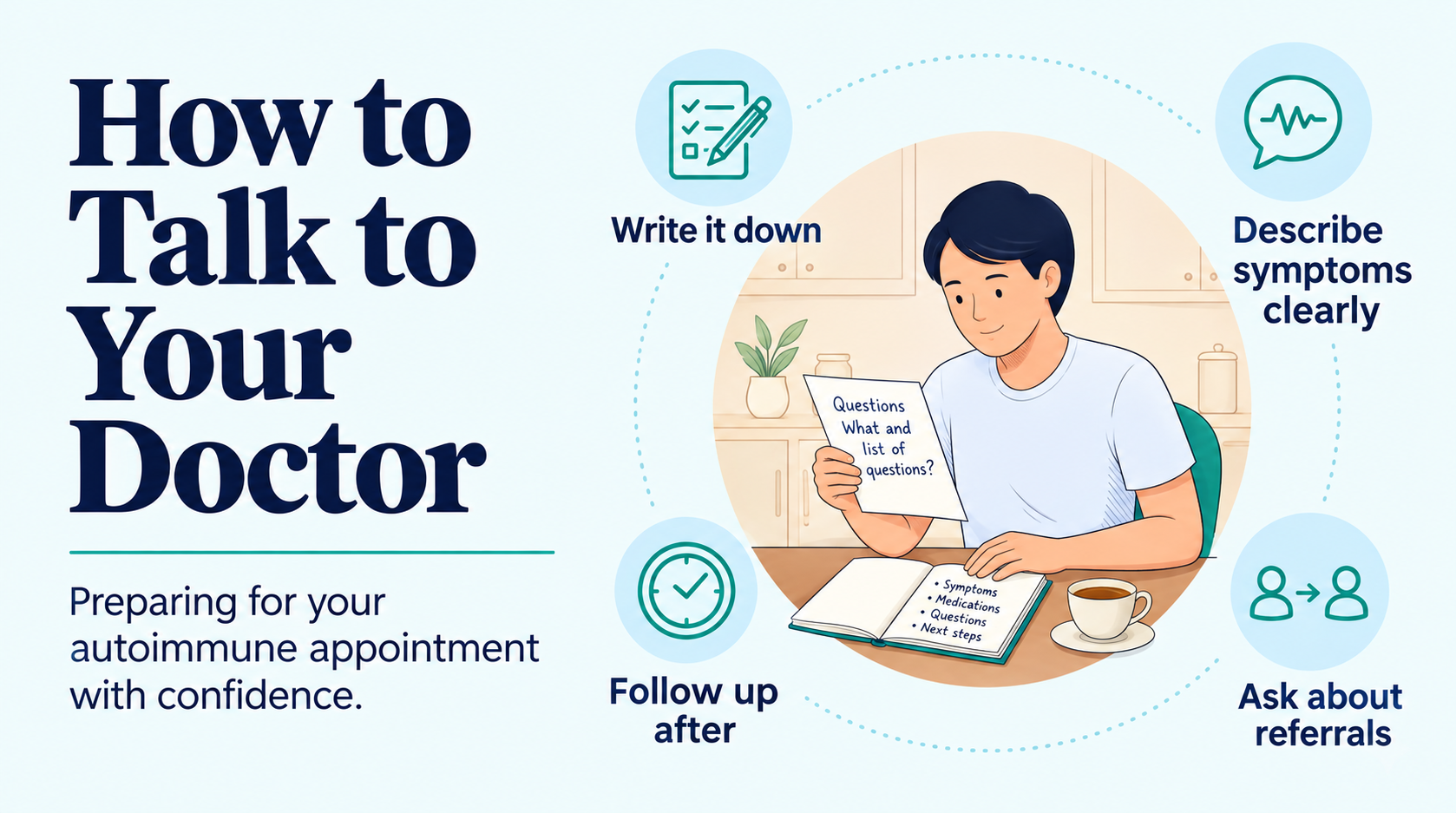
Key Takeaways
- Preparation, more than confidence alone, determines how productive an appointment becomes.
- A concise, prioritised list of questions is far more effective than attempting to recall everything in the moment.
- Specific, descriptive language about your symptoms helps your doctor understand your condition more quickly.
- Requesting a second opinion or a referral to an autoimmune specialist is a reasonable and widely accepted step.
- Following up after the appointment is just as important as the appointment itself.
Why It's Hard to Talk to Your Doctor After an Autoimmune Diagnosis
The Complexity of Autoimmune Disease Symptoms
Autoimmune disease rarely presents as a single symptom with a single explanation. Fatigue, joint pain, skin changes, digestive difficulties, and cognitive fog can all occur simultaneously, which makes the experience genuinely difficult to describe in a way that feels complete. Patients are often attempting to convey a complex, interconnected picture within a visit that may last only fifteen minutes.
Feeling Dismissed or Rushed in Appointments
Many people report feeling dismissed or rushed, particularly in the period before an autoimmune diagnosis is confirmed. This experience is valid, and it is one of the primary reasons people search for guidance on how to talk to their doctor more effectively. This is not because they are doing anything incorrectly, but because short appointment windows combined with overlapping symptoms make the process genuinely challenging to navigate.
How to Prepare Before Your Appointment
A modest amount of preparation goes a long way toward helping you feel in control of the conversation rather than simply reacting to it.
Track Your Symptoms
Even a brief note on your phone, describing what you experienced, when it occurred, and how long it lasted, transforms vague recollections into information your doctor can genuinely use. A simple symptom log is one of the most valuable things you can bring to an appointment.
Write Down Your Top Priorities
Determine in advance what matters most for this particular visit: a referral, a clear explanation of test results, or a plan for the coming weeks. Three to five written questions are consistently more effective than ten questions you are attempting to recall on the spot.
Bring Support If Possible
A family member or trusted friend accompanying you can help you remember what was actually discussed, particularly when an appointment covers a substantial amount of information.
If Language or Access to Care Feels Like a Barrier
AutoimmuneClarity's community spans the United States, the UAE, and more than 30 other countries, and healthcare systems look very different from one place to the next. A few things that can help, wherever you are:
- Ask the clinic in advance whether an interpreter is available, or bring someone who can translate for you.
- Write your main concern down in whichever language feels clearest to you, so nothing gets lost when it matters most.
- Not every clinic uses an online portal or app. If yours doesn't, ask what the equivalent is, such as a phone line, a physical file, or a scheduled follow-up call, so you still have a way to check in between visits.
| What to Bring | Why It Helps |
|---|---|
| A written symptom timeline | Turns fuzzy memories into something your doctor can actually work with |
| A short, prioritised question list | Keeps the conversation on track if the visit runs short |
| Notes on sleep, stress, and diet | Helps connect daily patterns to your autoimmune condition |
| A support person, if available | A second set of ears to catch what you might miss |
Questions to Ask Your Doctor About Your Autoimmune Condition
Knowing what to ask is often harder than the appointment itself. Many patients leave a visit with the same worries they walked in with, simply because the right words did not come to mind in the moment. The questions below are grouped by what patients most commonly want to understand, so you can choose the ones that match what you are feeling right now.
Understanding What's Really Happening
- “Could you explain what's happening in my body in terms I can clearly picture?”
- “Is what I'm experiencing connected to this condition, or could something else be responsible?”
- “Do we know what caused this?”
For example, someone recently diagnosed with Hashimoto's thyroiditis might ask their doctor, “Does this mean my thyroid will stop working completely, or can this be managed long-term?” Naming the condition you are actually facing, rather than speaking about it in the abstract, often makes the whole conversation feel less overwhelming.
You can find a deeper, condition-specific breakdown in our guide to Hashimoto's thyroiditis.
Prognosis and What Lies Ahead
- “Is this condition likely to progress, and what would that look like over time?”
- “Will I need ongoing visits, or does management typically become easier with time?”
- “Is there a version of this where I feel fully like myself again?”
Practical Next Steps
- “What is one change I could make this week that would genuinely help?”
- “What should I be monitoring or tracking between visits?”
- “Is there anything in my current routine that could be working against me without my realising it?”
Recognising Warning Signs
- “What symptoms would warrant an immediate call rather than waiting for my next appointment?”
- “What is considered typical for this condition, and what would be a signal to seek attention sooner?”
Feeling Heard and Respected
- “I understand that some patients with this condition feel dismissed. How can we make sure that doesn't happen here?”
You do not need to ask every question here. Choose the ones closest to what is on your mind, and write down the answers as your doctor responds.
How to Advocate for Yourself During the Visit
Self-advocacy is not about being confrontational. It is about communicating with clarity.
Lead With Your Primary Concern
If time is limited, ensure that your most important concern is addressed first rather than left for later in the conversation. State it clearly at the outset.
Use Specific, Descriptive Language
A statement such as "the joint pain is more pronounced in the morning and improves by midday" provides your doctor with considerably more useful information than "my joints hurt sometimes." Precise details about your autoimmune condition allow your doctor to identify patterns more effectively.
Request a Written Summary
A written summary, a printed handout, or a message through your clinic's online portal or messaging system, where available, recapping the visit gives you a reliable reference point and something to compare against during future appointments.
Recognise When a Second Opinion Is Appropriate
Autoimmune disease can be genuinely difficult to diagnose, and seeking a second perspective from an autoimmune specialist is a reasonable and accepted part of the process, not a reflection of distrust in your current physician.
What to Do After the Appointment
Review What Was Discussed
Revisit your notes, or those taken by your support person, within a day or two while the details remain fresh. Note anything that requires clarification at your next visit.
Outline Your Next Steps
Record what comes next: a testing date, a scheduled follow-up call, or a lifestyle adjustment to try, so that nothing is overlooked before your next appointment.
Walking This With You
Learning how to talk to your doctor is one component of living well with an autoimmune condition, though you need not navigate the rest of the journey alone. A concise list of questions, precise language about your symptoms, and the confidence to request a second opinion when necessary can transform a brief appointment into one that genuinely moves you forward.
AutoimmuneClarity's community connects you with others managing similar conditions and with autoimmune specialists who can help you better understand what you are experiencing, so that you may approach every appointment with greater confidence and preparation.
If you would like to hear how others prepared for this exact conversation, our Community is a good place to start. You can also browse our full library of condition guides to learn more about your specific diagnosis.
Note : This content is for educational and informational purposes only. It is not a substitute for professional medical advice, diagnosis, or treatment. Always consult your physician regarding any medical concerns or before making changes to your care plan.


