You Deserve Clarity: Learning About Your Condition Is Self-Care
Reviewed and approved by Dr. Prakruthi Jaladhar, Rheumatologist, Co-Founder
Self-Care Means Something Different With a Chronic Condition
Self-care ads tend to show the same handful of images. A candle. A bath. A quiet weekend away. None of that is wrong, exactly, but if you are managing an autoimmune condition, you already know that version of self-care can feel a little beside the point. A bath does not explain why your joints ache more on some days than others. A candle does not help you understand what your latest labs actually mean.
Real care, the kind that actually reaches a chronic condition, sometimes looks quieter and less picture-perfect than that. Sometimes it looks like sitting down, on your own terms, and finally understanding what your body has been trying to tell you all along.
Key Takeaways
- Learning about your condition is a legitimate form of self-care, not just information gathering.
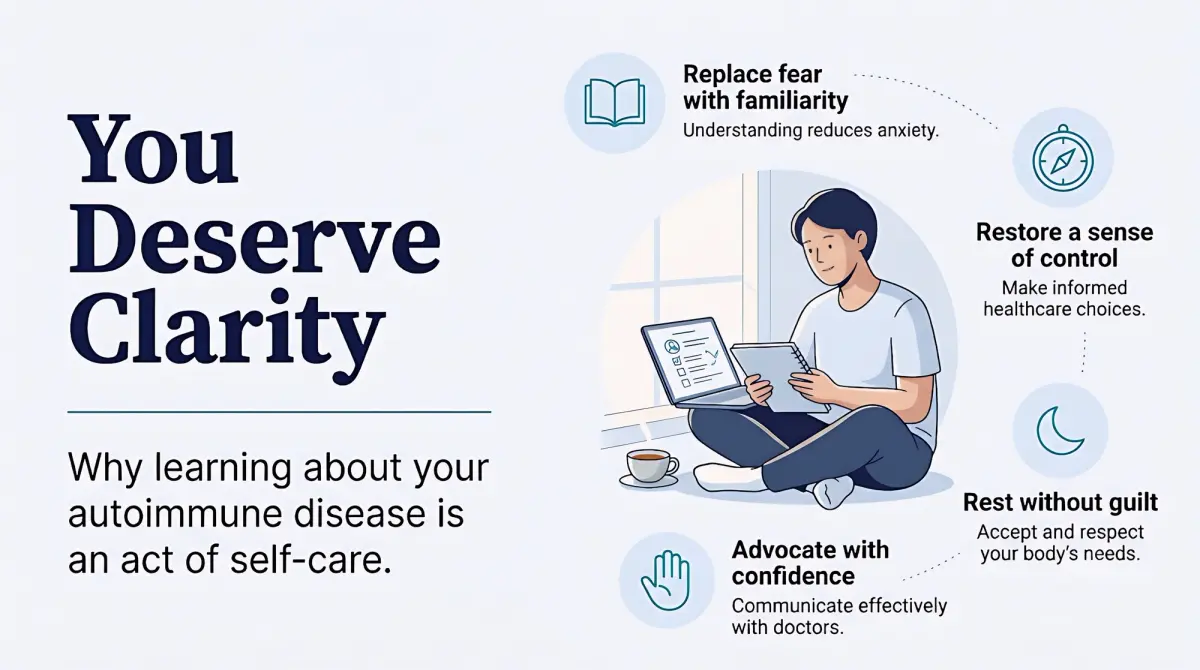
- Understanding your body tends to replace fear with familiarity over time.
- Education can restore a sense of control that a diagnosis often takes away.
- Knowing your condition well makes it easier to rest without guilt and advocate for yourself with confidence.
- You are allowed to prioritize learning about your health, even when life feels too busy for it.
Why Typical Self-Care Advice Often Misses the Point
The Bubble Bath Version of Self-Care Doesn't Cover This
Most mainstream self-care advice is built for stress relief, not chronic illness management. It assumes your body is a fairly steady baseline that just needs occasional pampering. That framing quietly leaves out anyone whose body needs more consistent understanding and attention than a spa day can offer.
This is not a criticism of rest or relaxation. Those matter too. It is simply a reminder that self-care with an autoimmune condition needs a wider definition, one that includes the less glamorous, more practical kind of care: understanding your labs, recognizing your patterns, and knowing what your body needs on an ordinary Tuesday, not just a spa Saturday.
Understanding Your Body Is a Form of Care Too
Think about what it actually feels like to sit with a question about your own health for weeks, unanswered. That uncertainty has a cost, even when it is invisible from the outside. Closing that gap, even a little, even one plain-language article at a time, is not a side project separate from your care. It is part of it.
What Learning About Your Condition Actually Gives You
It Turns Fear Into Familiarity
Unfamiliar things tend to feel scarier than they need to. A symptom that seems alarming in isolation often looks a lot less frightening once you understand it is a known, common part of your condition. Learning does not remove the symptom, but it often removes a layer of fear sitting on top of it.
It Restores a Sense of Control
A diagnosis can make your own body feel unpredictable, even unfamiliar. Understanding what is happening, even in general terms, hands some of that control back to you. You cannot control everything about a chronic condition, but you can control how well you understand it, and that matters more than it might seem.
It Makes Room for Rest Without Guilt
It is hard to rest guilt-free when you do not understand why your body needs it. Once you understand the general mechanics of your condition, a rest day stops feeling like laziness and starts feeling like exactly what it is, a reasonable response to a real, physical need.
How Education Becomes Empowerment
Knowledge Changes How You Advocate for Yourself
Walking into an appointment with a clearer understanding of your condition changes the entire conversation. You ask sharper questions. You notice when something does not add up. You stop nodding along out of politeness and start participating as an informed partner in your own care. That shift alone is a quiet, powerful form of self-respect.
Understanding Reduces the Emotional Load You Carry
Confusion is heavy to carry, even quietly. Every unanswered question about your body takes up a little bit of space in the back of your mind. Real autoimmune disease support often starts here, with fewer unanswered questions weighing on you day to day, which frees up energy for everything else in your life that deserves your attention.
Small Ways to Practice This Kind of Self-Care
Set Aside a Little Time to Learn, Not Just Manage
Most of the time we spend on our health goes toward managing it, appointments, medications, symptoms. Try setting aside a small, separate pocket of time, even fifteen minutes a week, purely to learn. Read one guide. Ask one question in a community discussion. Treat it as care, not homework.
Let Community Be Part of Your Self-Care
Understanding your condition does not have to be a solo project. Hearing how someone else makes sense of a similar experience can teach you things a solitary search never will, and it feels a lot less lonely too.
If you want a place to start, our community is built for exactly this kind of quiet, steady learning, alongside people who understand.
| Common Self-Care Advice | Self-Care With a Chronic Condition |
|---|---|
| Take a relaxing bath | Understand what your labs and symptoms actually mean |
| Treat yourself occasionally | Build a steady, sustainable understanding of your body over time and form a daily ritual that acts as an anchor for the rest of your day |
| Disconnect to de-stress | Connect with people who understand what you are living with |
| Rest when you feel burned out | Rest without guilt, because you understand why your body needs it |
Where to find information?
Ask your healthcare provider for information. It is best that you learn from a credible source rather than googling your symptoms or disease. Random search engine response can make you more anxious and are not personalized. Seek information from blog articles and community queries that can make you feel more understood. AI can also make mistakes. The queries that you don't find answers for can always be brought to your healthcare provider for deeper understanding. In this era of information overload finding the correct source can itself be daunting. Do not rely on quick fixes and do not randomly follow influencers. Identify few credible sources and dive into deeper research. Be careful about what you feed your mind.
Understanding Yourself Is Never Selfish
If you have ever felt a flicker of guilt for spending time learning about your own condition instead of just pushing through it, let this be the reminder you needed. Understanding your body is not indulgent, and it is not a distraction from your care. It is your care, in one of its quieter, steadier forms.
You deserve real clarity about what you are living with, not just management of it. AutoimmuneClarity's Community and guides exist to make that kind of self-care easier to reach, one honest, plain-language answer at a time.
Note : This content is for educational and informational purposes only. It is not a substitute for professional medical advice, diagnosis, or treatment. Always consult your physician regarding any medical concerns or before making changes to your care plan. If you are experiencing a medical emergency, call your local emergency number or go to the nearest emergency room.

