Addison's Disease and Skin Darkening: Why It Happens
Reviewed and approved by Dr. Prakruthi Jaladhar, Rheumatologist, Co-Founder
A quieter kind of clue
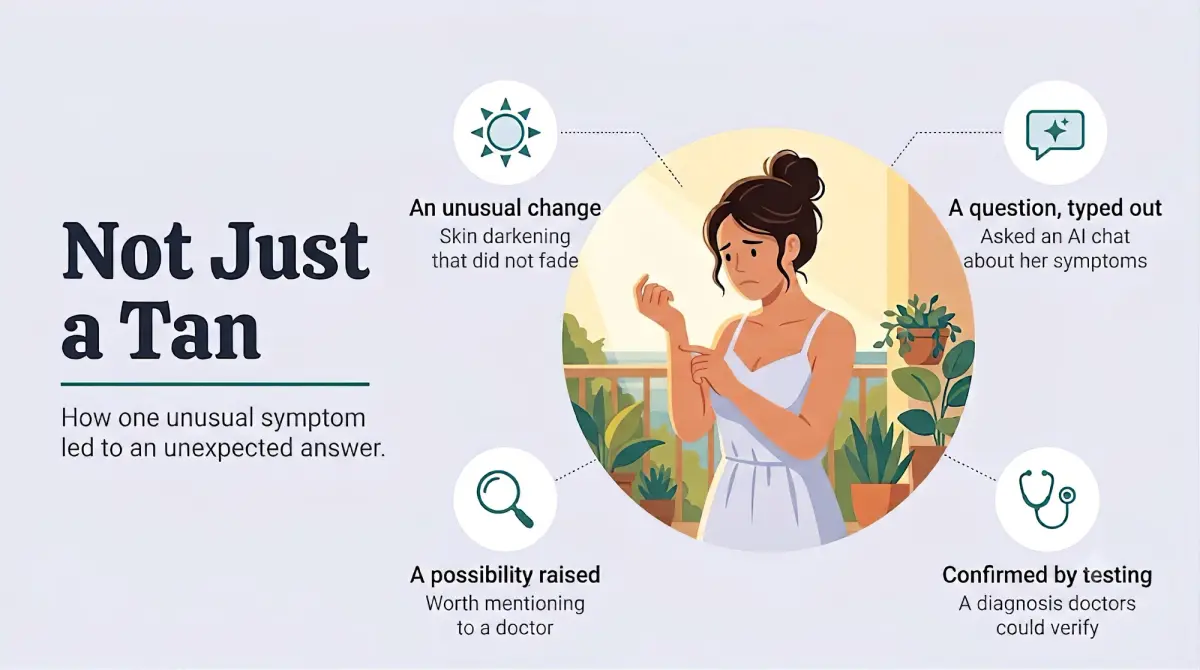
Earlier this month, a woman's story went quietly viral. She had been feeling exhausted for months, the kind of tired that sleep does not fix, and she had noticed her skin slowly turning darker in places that never used to tan, her knuckles, her gums, old scars. Doctors had run tests. Nothing had clicked yet. Out of curiosity, she described her symptoms to ChatGPT, and it raised a possibility her care team then confirmed: Addison's disease. Her story resonated with a lot of people for a simple reason. Skin darkening is one of the strangest, most overlooked clues in medicine, and almost nobody is told to look for it.
If you have noticed your own skin changing colour in patches, especially alongside fatigue that will not lift, you are probably here because you want to know if the two are connected. They might be. This condition is rare, but the skin changes it causes are distinctive once you know what you are looking at, and understanding why they happen is often the first step toward getting the right blood test instead of another round of guesswork.
This article walks through what is actually happening inside the body when this condition darkens the skin, what else tends to show up alongside it, and what diagnosis and daily life with this condition actually look like. It is written for the moment you are in right now: curious, maybe a little worried, and ready for a plain explanation instead of a wall of medical terms.
Key takeaways
- Addison's disease is a rare condition in which the adrenal glands stop producing enough cortisol, and often aldosterone, usually because the immune system has damaged them.
- Skin darkening happens because low cortisol triggers the pituitary gland to release more ACTH, and ACTH also stimulates pigment-producing cells in the skin as a side effect.
- The darkening often shows up first in places already prone to pigment: scars, skin folds, gums, and areas of frequent friction like knuckles and elbows.
- Fatigue, salt cravings, weight loss, and low blood pressure commonly appear alongside the skin changes, which is why Addison's is often mistaken for something else at first.
- Diagnosis relies on blood tests, most definitively an ACTH stimulation test, not on skin appearance alone.
- Addison's disease is manageable with daily hormone replacement, though it requires lifelong attention, including a plan for sick days and emergencies.
What Addison's disease actually is
The adrenal glands and what they normally do
The adrenal glands are two small organs that sit above the kidneys, and they produce hormones the body depends on constantly, including cortisol, which helps regulate metabolism, blood pressure, and the body's stress response, and aldosterone, which helps balance salt and fluid levels. Addison's disease, also called primary adrenal insufficiency, happens when these glands are damaged and can no longer produce enough of these hormones.
Why the adrenal glands stop working
In most cases, Addison's disease develops because the immune system mistakenly attacks and damages the adrenal cortex, the outer layer of the adrenal glands responsible for hormone production. This makes it an autoimmune condition, and it can occur on its own or alongside other autoimmune conditions. Less commonly, infections such as tuberculosis, certain cancers, bleeding into the adrenal glands, or genetic conditions can also cause it. This condition is rare, affecting roughly 1 in 100,000 people, and it most often appears between the ages of 30 and 50, though it can develop at any age.
Why skin darkening happens
The ACTH and melanin connection
This is the part that surprises most people, including many who are just noticing symptoms for the first time. When cortisol levels drop, the pituitary gland, which normally works in a feedback loop with the adrenal glands, responds by producing more ACTH (adrenocorticotropic hormone) in an attempt to push the adrenal glands into action. ACTH is built from the same larger precursor molecule as melanocyte-stimulating hormone, the hormone that tells pigment-producing cells in the skin to produce more melanin. When ACTH rises as high as it does when this condition goes untreated, it inadvertently stimulates those same pigment cells, which is why skin darkening, known clinically as hyperpigmentation, becomes one of the condition's most recognizable signs.
Where it shows up first
The darkening tends to appear most noticeably in areas that already have more pigment activity or friction: skin creases and folds, scars formed after the condition began, gums and the inside of the mouth, knuckles, elbows, knees, and areas exposed to sun. It can also appear as darker freckles or a general bronze or tan-like tone across the body, even without sun exposure, sometimes described as looking permanently tanned. On Black or brown skin, these changes can be harder to notice, which is one reason the connection is sometimes missed longer than it should be.
| Where it shows up | What it often looks like |
|---|---|
| Skin folds and creases | Darker patches where skin naturally creases, such as palms or elbows |
| Scars | Scars formed after the condition began often darken more than expected |
| Gums and mouth | Bluish-black or brown patches inside the mouth |
| Knuckles, elbows, knees | Areas of frequent friction darken more noticeably |
| Overall skin tone | A general bronze or tanned look, even without sun exposure |
The other symptoms that often go unnoticed
Fatigue, salt cravings, and weight change
Skin darkening rarely shows up alone. Most people with this condition also experience persistent fatigue that does not improve with rest, unintentional weight loss, low blood pressure, dizziness on standing, and a noticeable craving for salty foods, which relates to the drop in aldosterone and the body's resulting loss of sodium. Nausea, abdominal pain, and mood changes such as irritability or low mood are also common.
Why it's often mistaken for something else
Because these symptoms overlap with so many other conditions, from thyroid problems to chronic fatigue to simple stress, Addison's disease is frequently misdiagnosed or missed for months or longer. Skin darkening is often the detail that finally points a clinician in the right direction, precisely because it is unusual enough to prompt a more specific question: has your skin been changing color anywhere?
How Addison's disease is diagnosed
Blood tests and the ACTH stimulation test
Diagnosis typically starts with blood tests measuring cortisol, ACTH, and electrolyte levels. The most definitive test is the ACTH stimulation test, in which a synthetic form of ACTH is given and blood cortisol is measured before and after, to see whether the adrenal glands respond appropriately. Imaging of the adrenal glands and additional tests to identify the underlying cause, such as antibody testing for autoimmune adrenal disease, may follow a confirmed diagnosis.
Why an accurate diagnosis can take time
Because early symptoms are gradual and easy to attribute to other causes, it is common for people to see several different specialists before Addison's disease is identified, sometimes only after skin changes become noticeable enough to mention directly, or after a more severe adrenal crisis forces urgent evaluation. If you suspect this pattern in your own experience, mentioning skin darkening specifically, alongside fatigue and salt cravings, to your doctor can help point testing in the right direction sooner.
Living with Addison's disease day to day
Daily hormone replacement
Addison's disease is a lifelong condition, but it is generally well managed with daily hormone replacement, most often hydrocortisone or a similar corticosteroid to replace cortisol, plus fludrocortisone to replace aldosterone when needed. Most people take this medication multiple times a day, timed to mimic the body's natural hormone rhythm as closely as possible. The requirement of each individual varies, and it is advisable to follow the advice provided by your doctor and not to self-medicate which can become detrimental.
Sick day rules, adjusting for illness or stress
One of the most important parts of living with this condition is understanding sick day rules: during illness, injury, surgery, or significant stress, the body would normally produce extra cortisol on its own, and since that no longer happens automatically, medication doses often need to be temporarily increased under a specialist's guidance. Learning this pattern with your care team, before you need it in a crisis, is one of the most protective habits someone with this condition can build.
Carrying emergency identification
Because an adrenal crisis can escalate quickly and is not always obvious to someone unfamiliar with the condition, most specialists recommend carrying a medical alert card, bracelet, or similar identification stating that you have adrenal insufficiency and require steroid treatment in an emergency. Many people also carry an emergency steroid injection, prescribed and explained by their specialist, to use if they cannot take medication by mouth.
Understanding adrenal crisis
Warning signs
An adrenal crisis is a medical emergency that can occur when the body's cortisol levels drop too low, often triggered by illness, injury, or missed medication. Warning signs include sudden severe weakness, intense abdominal or back pain, vomiting, confusion, very low blood pressure, and fainting. This is different from ordinary Addison's fatigue, it develops quickly and feels distinctly more severe.
Why it's treated as a medical emergency
An adrenal crisis requires immediate treatment, typically emergency steroid injection followed by hospital care with intravenous hydrocortisone and fluids. If you or someone you know with this condition shows these signs, treat it as a genuine emergency and seek immediate medical attention rather than waiting to see if it passes.
A pattern worth naming to your doctor
If any of this sounds familiar, unexplained fatigue, salt cravings, skin that seems to be quietly darkening in places it never used to, it is worth naming that pattern out loud to a doctor, clearly and specifically. Addison's disease is rare enough that it is not always the first thing considered, and common enough that it deserves to be on the list when the usual explanations do not fit.
You do not need to have all the answers before that conversation. You just need to describe what you are actually noticing, including the parts that feel strange or hard to explain, like skin that will not stop changing color. Sometimes that is exactly the detail that moves things forward.
If this felt useful, explore AIC's Addison's disease and adrenal health guide for a deeper look at daily management, or join the AIC community to hear from others who have navigated diagnosis and life with this condition.


