Ankylosing Spondylitis Exercise: What Specialists Now Recommend
Reviewed and approved by Dr. Prakruthi Jaladhar, Rheumatologist, Co-Founder
A gentle place to start
If your mornings start with a stiff back before your feet even touch the floor, you already know something that no textbook can fully explain: ankylosing spondylitis changes the way your day begins. Some mornings the stiffness eases within the hour. Other mornings it lingers, and every stretch to reach for your coffee cup reminds you it is still there.
You are not the only one who feels this way, and you are not doing anything wrong. Ankylosing spondylitis, often shortened to AS, is a form of axial spondyloarthritis that causes inflammation mainly in the spine and the joints where the spine meets the pelvis. Over time, that inflammation can affect posture, flexibility, and even how deeply you can breathe. It can feel like your own body has become unpredictable.
Here is the part that specialists want more people with AS to hear clearly: movement is not just something that helps alongside treatment, it is one of the most protective things you can do for your spine and joints, right alongside whatever your care team has prescribed. This guide walks you through what physiotherapists and rheumatology specialists currently recommend, in plain language, with no assumption that you already know the medical terms. Whether you were diagnosed last month or have been living with AS for twenty years, consider this a companion to return to whenever you need a reminder of where to start, or where to start again.
Key takeaways
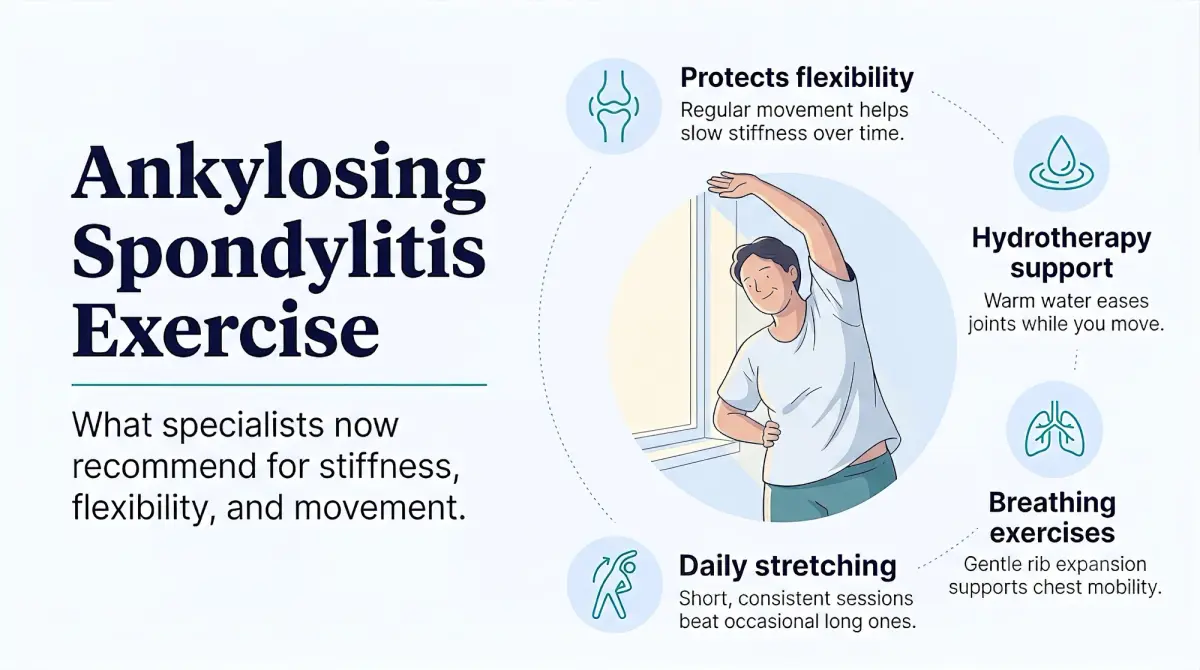
- Regular movement is one of the most consistently recommended parts of AS management, easing stiffness and protecting flexibility.
- Specialists generally recommend a mix of stretching, strengthening, low-impact cardio, and breathing exercises, not one single activity.
- Swimming and hydrotherapy are frequently highlighted because warm water supports the joints while you move.
- Consistency matters more than intensity. Short, regular sessions tend to help more than occasional long ones.
- Gentle movement, not none at all, is usually still encouraged during a flare.
- A physical therapist familiar with axial spondyloarthritis can tailor a routine to your body, since AS affects everyone differently.
Why movement matters more than you might think
What is actually happening in your spine and joints
Ankylosing spondylitis causes inflammation where ligaments and tendons attach to bone, most often in the spine and sacroiliac joints (the joints between your pelvis and your spine). Left unaddressed over years, this inflammation can lead to new bone formation, which in some people gradually reduces spinal flexibility. This is exactly why staying mobile is not just about comfort today, it is about protecting the range of motion you have for the rest of your life.
What specialists actually see in patients who stay consistent
Physiotherapists who work with AS patients regularly describe the same pattern: people who keep moving, even gently, tend to maintain better posture, better chest expansion for breathing, and better day-to-day function than those who rest completely. Exercise will not undo the condition, and no guide should promise that it will. What it can do is help you hold on to flexibility, ease stiffness, and support your body as your treatment plan does its part.
The types of movement specialists recommend
Most specialist guidance points toward a combination of the following, rather than any single exercise being described as the answer.
Stretching and flexibility work
Gentle daily stretching, especially for the spine, hips, and shoulders, helps counter the tightening that AS can cause. Many people find it easiest right after a warm shower, when muscles are already a little looser.
Strengthening exercises for your back and core
A stronger back and core help support posture and take some pressure off the spine. Specialists often recommend controlled strengthening exercises for the muscles along the spine, the shoulders, and the abdomen, ideally introduced gradually and with guidance so the movements stay safe for your particular joints.
Low-impact cardio: swimming, walking, and cycling
Swimming is one of the most frequently recommended activities for AS, since water supports body weight while letting you move many joints and muscles without jarring impact. Walking and cycling are also commonly suggested as accessible ways to build cardiovascular fitness without added strain on the spine.
Hydrotherapy, and why warm water helps
Hydrotherapy, exercising in a warm water pool, is highlighted by several specialist organizations because the warmth can ease muscle tension while the water's buoyancy takes weight off the spine and hips. Some physiotherapy clinics offer hydrotherapy sessions specifically designed for people with spondyloarthritis.
Mind-body movement: yoga, pilates, and tai chi
These practices combine flexibility, gentle strength work, and breath awareness, which lines up closely with what AS bodies benefit from. A slower, beginner-friendly class, ideally with an instructor who understands AS or who can adapt poses, tends to work better than a fast-paced session.
Breathing exercises, the part people often forget
Because AS can affect the joints between the ribs and spine, chest expansion and lung capacity can quietly become part of the picture over time. This is one of the most overlooked areas of AS movement, and specialists consistently recommend not skipping it.
A simple rib expansion exercise you can do lying down
Lie on your back with your knees bent and feet flat. Place your hands gently on the sides of your ribs. Breathe in slowly through your nose, feeling your ribs push out against your hands, then breathe out slowly. A few minutes of this, once or twice a day, is a small habit that supports a part of AS that is easy to forget about until it is noticed.
Building a routine that fits your real life
You do not need a perfect, elaborate plan. You need something you can actually keep doing.
A sample gentle weekly rhythm
| Day | Focus | Example |
|---|---|---|
| Monday | Stretching and posture | 10 minutes of spinal and hip stretches |
| Tuesday | Low-impact cardio | 20 to 30 minute walk or swim |
| Wednesday | Strengthening | Gentle core and back strengthening, guided by a physical therapist if possible |
| Thursday | Breathing and rest | Rib expansion breathing plus light stretching |
| Friday | Low-impact cardio | Cycling, swimming, or a longer walk |
| Saturday | Mind-body movement | Yoga, pilates, or tai chi |
| Sunday | Rest or gentle movement | Short walk or stretching, guided by how your body feels |
This is only an example. Your own week may look different depending on your job, your energy, and how your body feels that day, and that is completely fine. As the movements feel comfortable you can build your strength by adding a graded increase in the movement intensity and /or the number of repetitions.
What to do the moment you wake up
Many people with AS find the first few minutes after waking are the stiffest part of the day. A short, gentle stretching routine before you even get out of bed, followed by a warm shower, is a combination many specialists suggest as a practical way to ease into the day rather than fighting through it.
Fitting movement into a busy day
If a full routine feels unrealistic some days, specialists generally agree that short, frequent movement breaks, a few minutes of stretching every hour, a walk at lunch, standing up regularly if you sit for work, add up and matter more than skipping movement entirely because you cannot fit in a long session.
Posture habits that support everything else
Exercise and posture work together. Good posture habits during the rest of your day help protect the progress your exercise routine builds.
Everyday posture checks
Try to keep your shoulders relaxed rather than hunched, and your chin roughly parallel to the ground rather than dropped forward. A simple monthly check, standing with your back against a wall to notice any changes in your posture, can help you and your care team track things over time.
Setting up your space for support
An upright chair with proper lower back support, a monitor positioned at eye level, and reminders to avoid staying in one position for too long all make a real difference over the course of a day. Small adjustments to where you sit and how you sit add up.
Being gentle with yourself during flares
Signs it is time to slow down, not stop
During a flare, pain and stiffness can increase, and pushing through a full routine is not usually the right move. Most specialist guidance suggests scaling back to gentler movement, like light stretching or short walks, rather than stopping activity altogether, since some movement generally supports the body better than none. Always let pain guide the intensity and reach out to your care team if a flare feels different from your usual pattern.
Working with a physical therapist
Because AS affects every person differently, a physical therapist familiar with axial spondyloarthritis can help build and adjust a routine around your specific joints, your flexibility, and your flare patterns. This kind of individualized routine building is exactly the sort of guidance a qualified physical therapist provides, and it goes beyond what any general guide, including this one, is able to offer.
Carrying this with you
Living with ankylosing spondylitis is not about chasing a perfect routine. It is about finding small, steady habits that help you feel a little more like yourself, one gentle stretch, one short walk, one deep breath at a time. Some days that will look like a full routine. Other days it will look like ten minutes of stretching before bed, and that still counts.
You know your body better than any guide ever could. Let this be a starting point, not a strict rulebook, and let your care team help you shape it into something that truly fits your life.
If this felt useful, explore AIC's guide for a deeper, structured look at daily habits, or join the AIC community to see how others living with AS build their own movement routines and share what has helped them.
References and sources
- Spondylitis Association of America, "Exercise" — spondylitis.org
- National Axial Spondyloarthritis Society, "Managing my AS: Exercise" — nass.co.uk
- Versus Arthritis, "Ankylosing Spondylitis" — versusarthritis.org


