What does an autoimmune flare actually feel like?
Key Takeaways
- An autoimmune flare is a period when your immune system becomes more active than usual, causing your symptoms to intensify or return after a stretch of feeling relatively well.
- Flares often involve a combination of deep fatigue, increased pain or stiffness, brain fog, and sometimes new symptoms you have not experienced before.
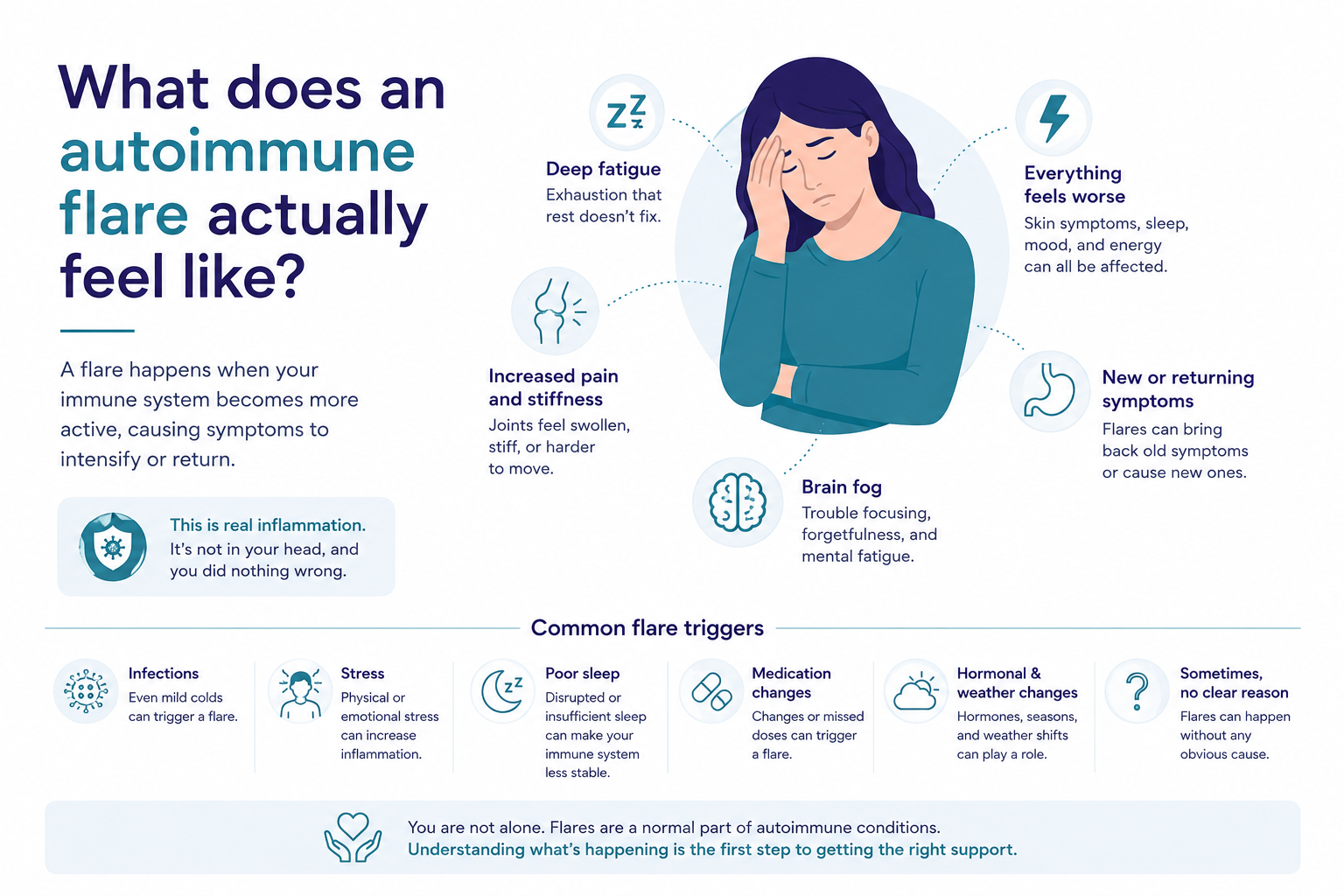
- Common triggers include infections, stress, poor sleep, and changes in medication, though sometimes flares happen without any obvious cause.
- Knowing the difference between a rough day and a true flare helps you communicate more clearly with your care team.
You were doing fine. Not perfect, but fine. Your condition felt managed. You were sleeping reasonably well, keeping up with work, making plans. And then one morning, something shifted. Your joints felt thick and heavy. Your thinking went fuzzy. The fatigue came back like it had never left. By afternoon, you were canceling everything and wondering what went wrong.
If you are newly diagnosed, this is confusing. If you have been living with an autoimmune condition for a while, it is familiar. Either way, nobody prepares you for how disorienting a flare can feel.
An autoimmune flare is a period of increased disease activity where your immune system ramps up its response, driving a rise in inflammation that causes symptoms to intensify or return. Flares can last days, weeks, or sometimes longer, and they are a normal part of living with most autoimmune conditions, not a sign that your treatment has failed or that you did something wrong.
What is actually happening in your body during a flare?
Your immune system, in autoimmune conditions, is already producing an ongoing low-level response against your own tissues. During a flare, that response escalates. Research published in PLOS Computational Biology describes flares as "excitable dynamics," meaning the immune system crosses a threshold where the balance between the cells driving the attack and the regulatory cells trying to keep them in check tips in the wrong direction.
When that happens, your body produces more inflammatory molecules, including cytokines like IL-6 and TNF-alpha. These are the same proteins your immune system would ramp up during an infection, except in a flare, there is no infection to fight. The result is real, measurable inflammation that affects whichever tissues your condition targets: joints, skin, thyroid, kidneys, or elsewhere.
This is not in your head. It is not because you ate the wrong thing or forgot to meditate. It is your immune system doing what autoimmune conditions make it do.
What does a flare feel like, in real terms?
Clinical descriptions of flares list things like "increased disease activity" and "elevated inflammatory markers." Those are accurate, but they do not capture what it actually feels like to live through one.
Here is what our medical team hears from patients most often.
The fatigue comes first for many people. Not tired. Depleted. The kind of exhaustion where lifting your phone feels like effort. You may have slept a full night and still wake up feeling like you ran a marathon. Some patients describe it as their body shutting down, like a phone dropping from 40% battery to zero with no warning.
Pain changes character. If you have joint involvement, your baseline stiffness or achiness intensifies. Morning stiffness that usually lasts 20 minutes might stretch to an hour or more. Joints that were manageable suddenly feel swollen, hot, or difficult to move. Some people notice pain spreading to areas that do not usually bother them.
Brain fog rolls in. Words that were on the tip of your tongue disappear. You read the same paragraph three times. You walk into a room and forget why. Cognitive difficulties during flares are well documented and affect memory, concentration, and decision-making. Patients often say this is the most frustrating part because it makes them feel like they are losing themselves, not just their energy.
Everything else gets louder too. Skin symptoms may worsen. Appetite may drop. Sleep becomes less restorative even if you are getting more of it. Mood shifts are common, not because you are weak, but because inflammation directly affects brain chemistry. Anxiety, irritability, and a sense of being overwhelmed are all part of the biological reality of a flare, not a character flaw.
What triggers a flare?
Sometimes you can trace it. An infection, even a mild cold, is one of the most common triggers. Research shows that viral reactivations, including Epstein-Barr virus and other common herpes viruses, can drive immune flares even without causing obvious illness. Stress is another well-documented trigger. A 2008 study in Autoimmunity Reviews found that up to 80% of patients reported significant stress prior to the onset of their disease, and stress continues to be linked to flare activity throughout the course of illness.
Other common triggers include poor or disrupted sleep, overexertion (physical or emotional), changes in medication or missed doses, hormonal shifts, and weather or seasonal changes.
But sometimes, a flare just happens. There is no identifiable trigger, no clear mistake you made. That is the nature of autoimmune conditions. The immune system has its own rhythms, and they are not always predictable. Our team has worked with many patients who blame themselves when a flare hits, looking for something they did wrong. More often than not, the answer is that autoimmune disease is simply unpredictable, and self-blame only adds to the burden.
How do you know if it is a flare or just a bad day?
This is one of the most common questions newly diagnosed patients ask. The honest answer is that the line between the two can be blurry, especially early on when you are still learning your body's patterns.
A general way to think about it: a bad day usually resolves within 24 to 48 hours with rest. A flare tends to build over several days, involves multiple symptoms worsening at once, and does not resolve with a good night of sleep. If your symptoms are noticeably worse than your baseline and have been persistent for more than two or three days, that pattern is worth paying attention to.
Keeping a simple symptom log, even just a few notes on your phone each evening, can help you spot patterns over time and give your doctor something concrete to work with.
When to reach out to your care team
You know your body better than anyone. If something feels different from your usual baseline, that instinct matters. Specifically, consider reaching out to your doctor if your symptoms have been escalating for more than a few days and are not improving with rest, if you are experiencing new symptoms you have not had before, if you develop a fever alongside your usual symptoms, if your current medications do not seem to be managing things the way they usually do, or if your daily functioning is significantly affected and you are unable to work, care for yourself, or do basic tasks.
You do not need to wait until things are severe. A phone call or message to your care team when a flare is building is always better than waiting until you are in crisis. Early communication can sometimes make the difference between a short flare and a prolonged one.

