Why am I still tired when my labs look normal?
Key Takeaways
- Autoimmune fatigue is a real, measurable biological process driven by inflammation, not a sign that you are lazy, deconditioned, or "just stressed."
- Routine blood work like CBC and basic metabolic panels often comes back normal because it does not measure the low-grade inflammation and immune activity that drive autoimmune fatigue.
- Up to 70% of people living with rheumatoid arthritis and similar autoimmune conditions report persistent fatigue, even when their disease appears well controlled on paper.
- There are specific questions you can bring to your next appointment that may help your doctor look deeper.
You slept eight hours. Maybe nine. You woke up feeling like you had not slept at all. Your partner looks at you and says, "But you just rested all weekend." Your lab results came back and everything is in range. Your doctor says things look good.
And you are still so tired you could cry.
This is one of the most common experiences shared by people living with autoimmune conditions. If you have felt this way, you are not imagining it, you are not being dramatic, and you are not alone.
Autoimmune fatigue is a distinct biological phenomenon driven by ongoing immune activity and inflammation, and it often persists even when standard lab results appear normal. Approximately 60% to 70% of patients with autoimmune conditions like rheumatoid arthritis, lupus, and Hashimoto's thyroiditis report persistent, significant fatigue, making it one of the most common symptoms across nearly every autoimmune condition.
Why does autoimmune fatigue feel so different from regular tiredness?
There is an important distinction here. Regular tiredness has a clear cause and a clear solution. You stayed up late, you feel tired the next day, you sleep, you feel better. That cycle makes sense.
Autoimmune fatigue does not follow that pattern. It can hit in the middle of the day after a full night of sleep. It does not respond to rest the way ordinary tiredness does. Many patients describe it as feeling like they are moving through wet concrete, or like someone pulled the plug on their battery. It is not just sleepiness. It is a deep, bone-level exhaustion that affects your ability to think, to concentrate, to get through a normal afternoon.
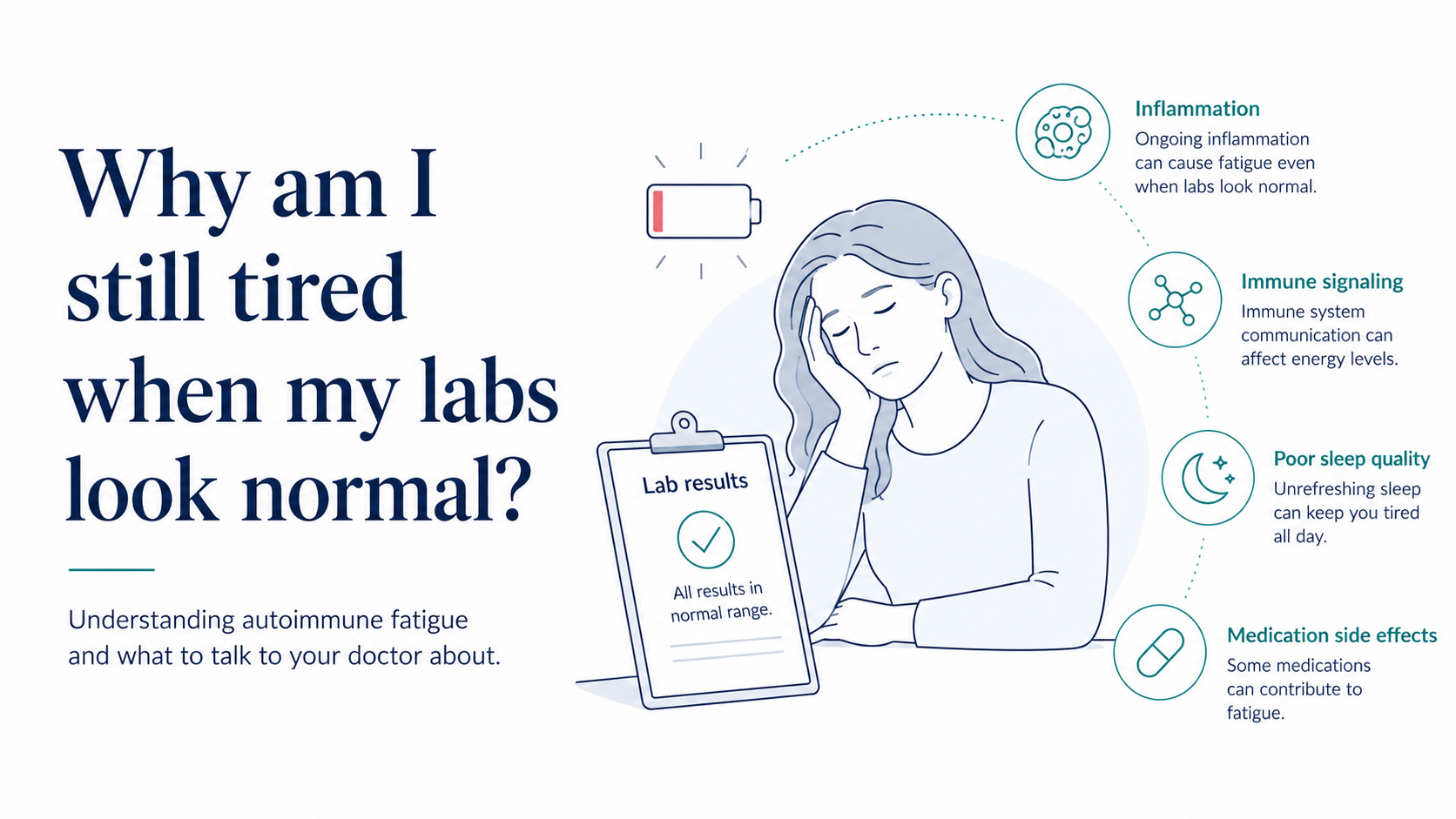
The reason it feels different is because it is different. In autoimmune conditions, the immune system is chronically active. That activity produces inflammatory molecules called cytokines, proteins like IL-1, IL-6, and TNF-alpha. Research published in the journal Frontiers in Bioscience shows that these cytokines cross into the brain through several pathways, including the vagus nerve, and directly alter how your brain produces energy and regulates wakefulness. Your body is essentially running an immune response in the background at all times, and that takes an enormous amount of energy, even when you cannot see it on a blood test.
Why do my labs look normal if this is real?
This is the question that frustrates patients most, and it is a fair one.
Standard blood work typically checks things like your complete blood count, thyroid hormone levels, and basic metabolic markers. These tests are valuable, but they were not designed to detect the kind of low-grade, tissue-level inflammation that drives autoimmune fatigue. Your CRP or ESR might be within range. Your thyroid numbers might look fine. And yet the immune activity happening at a cellular level, inside your joints, your glands, or your nervous system, can still be producing enough inflammatory signaling to leave you exhausted.
Think of it this way. A smoke detector only goes off when there is enough smoke in the room. But a small fire in the walls can burn for a long time before the smoke reaches the sensor. Standard labs are like the smoke detector. They are good at catching big, obvious problems. They are less good at catching the slow, steady burn of autoimmune inflammation that may not produce dramatic numbers but absolutely produces dramatic fatigue.
Our medical team has worked with many patients over the years who have heard some version of "your labs look fine" while feeling anything but fine. That disconnect is real, and it is one of the most isolating parts of living with an autoimmune condition.
What else could be contributing?
Autoimmune fatigue rarely has a single cause. Several factors often overlap, and it is worth being aware of them so you can raise them with your care team.
Sleep disruption is common in autoimmune conditions, even when you feel like you are sleeping enough. Pain, even mild pain you have gotten used to, can fragment sleep quality without you realizing it. Many autoimmune medications, including methotrexate and certain biologics, list fatigue as a known side effect. Nutrient deficiencies, particularly iron, vitamin D, and B12, are more common in people with autoimmune conditions and can compound the exhaustion. And the emotional weight of managing a chronic condition, the stress, the uncertainty, the effort of explaining yourself to others, takes its own toll on energy.
These are not excuses. They are real, identifiable factors that a knowledgeable physician can help you sort through.
One thing you can bring to your next appointment
Consider writing down this question for your doctor: "Given that my fatigue is persistent even though my standard labs look normal, are there additional markers we could check, like anti-thyroid antibodies, vitamin D, ferritin, or a more detailed inflammatory panel?"
That single question opens the door to a more specific conversation. It tells your doctor that you have done some reading, that you take this symptom seriously, and that you are looking for partnership, not a quick fix.
